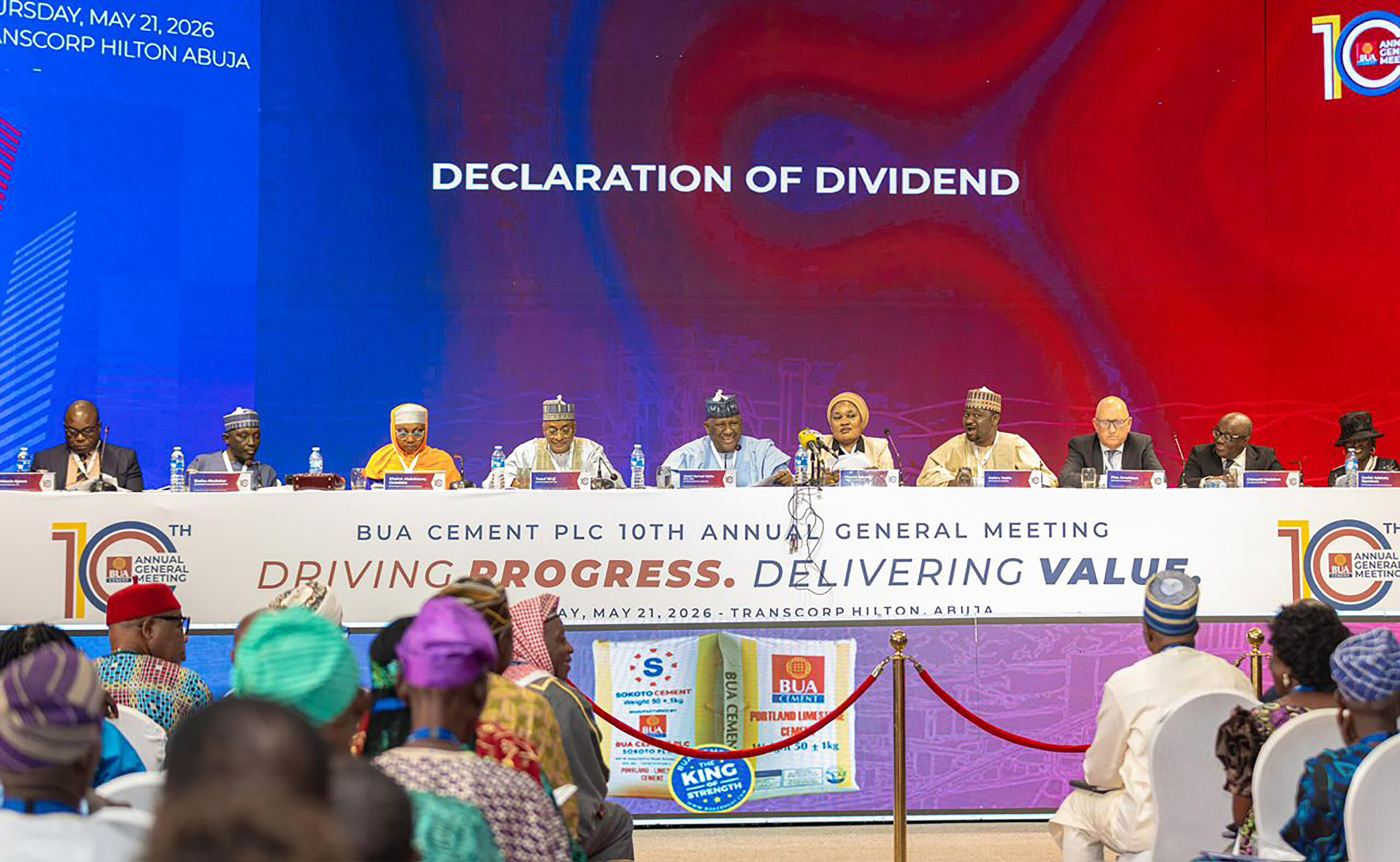
Shareholders of BUA Cement Plc have commended the company's strong financial performance for the 2025 financial year, culminating in the approval of a N10.00 dividend per share at its 10th Annual General Meeting in Abuja.
BUA Cement announced a record revenue of N1.2 trillion for 2025, a 34.5% increase from N876.5 billion in 2024. Gross profit rose to N604.1 billion from N300.2 billion in the previous year. The company's Profit After Tax (PAT) saw a dramatic leap from N73.9 billion in 2024 to N356 billion in 2025, marking a 381.7% increase. Earnings per share also climbed to N10.00 from N2.18k.
The company's Chairman, Abdul Samad Rabiu, and the executive management were lauded for their strategies in navigating a volatile year. Shareholders also acknowledged the company's employee recognition programs and philanthropic efforts.
Mr. Rabiu expressed gratitude for shareholders' loyalty and trust, stating that their belief is the foundation for the company's impressive performance. He emphasized that despite economic reforms and challenges, BUA Cement has emerged stronger and remains committed to its expansion plans and safeguarding capital.
He further noted that the upcoming commissioning of the BUA LNG project later in the year is expected to reduce operating costs by providing a more cost-effective energy alternative for its plants. BUA Cement's growth strategy is closely aligned with Nigeria's industrial development.
Factors Affecting Cement Pricing
BUA Cement Plc has identified rising energy, transportation, and foreign exchange-related expenses as key drivers of high cement prices in Nigeria. Chairman Abdul Samad Rabiu stated that the cement industry is significantly impacted by the import of spare parts, equipment, and energy inputs, making it vulnerable to exchange rate fluctuations.
While recent stability in the foreign exchange market has begun to ease some pressures, particularly in shipping and logistics, the industry continues to face production cost pressures. Mr. Rabiu mentioned that the reforms, though initially difficult, have led to a more transparent market with improved access to foreign exchange for manufacturers.
Yusuf Binji, the Managing Director and Chief Executive Officer, elaborated that energy costs constitute approximately 60% of cement production expenses. He cited a sharp increase in natural gas costs at one of the company's plants in Edo State, which escalated from nearly N4 billion to N16 billion per month at one point.
Mr. Binji also highlighted the impact of rising diesel prices, which have significantly affected transportation and distribution costs. Diesel prices supplied to the company's factories reportedly rose from about N930 per litre in March to nearly N1,850 per litre within two months. He estimated that transportation costs account for half the price of a bag of cement.
He refuted claims that cement was selling for N13,000 to N15,000 per bag nationwide, stating that prices in several regions were lower, with the northern region selling at N11,100 per bag as of the previous day. The company assures consumers that prices will be reviewed in line with economic realities and input cost changes.
Despite economic challenges, BUA Cement is proceeding with expansion projects. A new production line in Ososo, Edo State, is nearing completion, and another is planned for Sokoto State. These projects are expected to add six million tonnes to the company's annual production capacity, bringing the total installed capacity to approximately 23 million tonnes per annum by 2027. The company has also invested in bulk cement distribution by acquiring 500 specialized trucks.